In the modern, hyper-connected commercial landscape, establishing a robust online presence is not just a competitive advantage; it is a critical necessity for business survival and growth. From local service providers in Lahore to burgeoning e-commerce platforms scaling across Pakistan, companies are increasingly turning to specialized digital marketing agencies to navigate the complex world of search engines, social media algorithms, and paid advertising. However, partnering with the wrong agency can lead to wasted budgets, missed opportunities, and damage to your brand reputation.
With thousands of agencies offering similar services, selecting the ideal partner is a complex decision. Choosing the right digital marketing agency requires strategic alignment, thorough vetting, and a clear understanding of your commercial objectives. In this comprehensive 1,200+ word guide, we will explore the essential steps, critical selection criteria, and red flags to watch for when choosing a digital marketing agency to accelerate your business growth predictably.
Why Your Business Needs a Strategic Digital Marketing Agency Partner
Before diving into the selection process, it is essential to appreciate the value a specialized agency brings to your organization. Attempting to manage all digital marketing channels in-house is often inefficient and prohibitively expensive for most small to medium-sized enterprises.
Here are the primary strategic benefits of partnering with a professional agency:
- Access to specialized, Full-Stack Expertise: Digital marketing requires diverse skill sets, including SEO, PPC management, content creation, social media strategy, and data analytics. An agency provides immediate access to a team of experts specialized in each discipline.
- Scalability and Budget Flexibility: Agencies allow you to scale your marketing efforts up or down based on business seasonality, product launches, or budget availability without the overhead of hiring and training new employees.
- Advanced Technology and Tools: Professional agencies invest heavily in premium marketing tools (e.g., Ahrefs, SEMrush, HubSpot, Sprout Social) for research, tracking, and automation. Accessing these tools in-house can be extremely costly.
- Objectivity and Strategic Insight: An external agency offers a fresh, data-driven perspective on your marketing strategies, helping identify blind spots and opportunities that internal teams might miss.
At MadiGiServices, we emphasize the importance of blending multi-channel expertise with custom strategy development to maximize return on ad spend (ROAS) and drive qualified lead generation.
Step-by-Step Guide to Choosing the Right Digital Marketing Agency
Follow this rigorous selection framework to ensure you partner with an agency that delivers measurable commercial results:
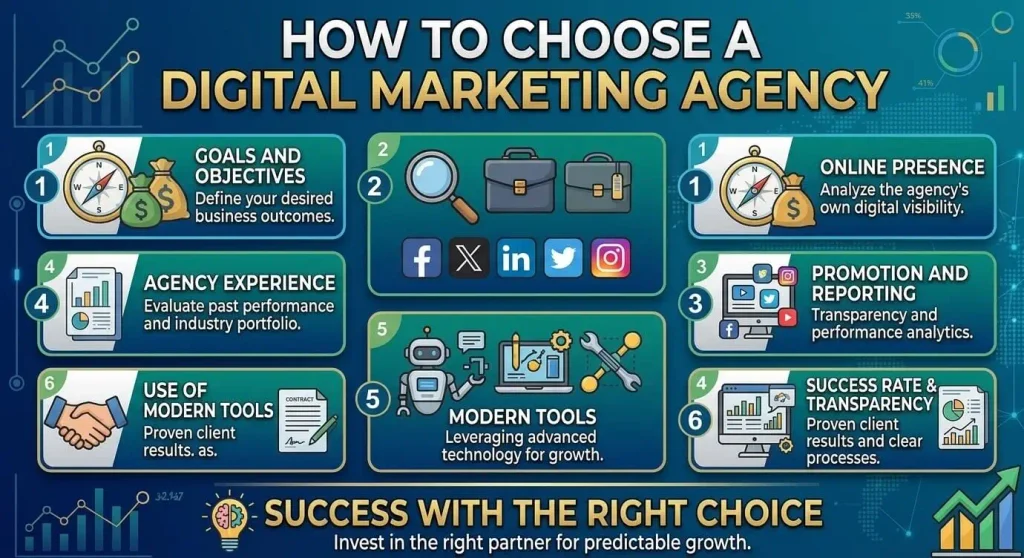
Step 1: Internally Define Your Marketing Goals and Budget
The first mistake businesses make is contacting agencies without clear objectives. Define what you need to achieve. Are you looking for top-of-funnel brand awareness (reach), middle-of-funnel lead generation (phone calls or form submissions), or bottom-of-funnel sales checkouts?
Establish a realistic monthly budget framework. Agencies have different pricing models (monthly retainers, project-based, or performance-based). Knowing your budget allows you to filter agencies that fit your financial parameters immediately.
Step 2: Determine the Required Scope of Services
Digital marketing is an umbrella term. Identify which specific services your business currently needs to achieve its defined goals:
- Search Engine Optimization (SEO): To improve organic visibility and attract non-paid traffic from Google.
- Pay-Per-Click (PPC) Advertising: To get immediate visibility through paid ads on Google (Search/Display) and social networks.
- Social Media Marketing (SMM): To engage audiences and run targeted campaigns on platforms like Meta, LinkedIn, or TikTok.
- Content Marketing: To educate, attract, and retain customers through valuable blog posts, videos, and guides.
- Web Design & Conversion Rate Optimization (CRO): To optimize your landing pages for higher inquiry or purchase rates.
Some agencies specialize (e.g., SEO-only agencies), while full-service agencies manage comprehensive, multi-channel strategies.
Step 3: Conduct Thorough Research and Create a Shortlist
Begin your search by looking for agencies that display visible expertise in their own marketing. If an agency claims to excel at SEO but doesn’t rank on the first page of Google for relevant terms, take caution.
Search for niche-specific expertise. An agency with experience in your industry (e.g., real estate, e-commerce, or B2B SaaS) already understands your buyer personas and regulatory environment, reducing the learning curve.
Step 4: Vet Agency Credibility, Proof, and Case Studies
Never take an agency’s claims at face value. Look for tangible proof of performance. Review their client portfolio, read Google Business reviews, and inspect their website for detailed, data-driven case studies.
A legitimate agency should be able to showcase case studies detailing:
- The specific client challenge or goal.
- The strategic approach and executed tactics.
- Measurable, quantified results (e.g., “Increased lead volume by 150% in 6 months,” “Boosted ROAS by 4x”).
To examine optimized agency performance data and case study frameworks, review the service agency examples at MadiGiServices.
Step 5: Interview and Evaluate Strategic Alignment
Arrange consultation calls with your shortlisted agencies. These calls are critical to evaluating cultural fit and communication style. Ask probing questions, such as:
- “How do you measure success and what key performance indicators (KPIs) do you track?”
- “Who will be the dedicated account manager, and how frequently will we receive performance reports?”
- “What strategies will you implement specifically for our industry and target audience?”
- “Can you share examples of past campaign challenges and how your team resolved them?”
Step 6: Review Pricing Models and Contract Terms
Understand the agency’s billing structure before signing any agreement. Common agency pricing models include:
- Monthly Retainer: A fixed monthly fee for ongoing services such as SEO, content creation, and ad management.
- Project-Based Pricing: A one-time fee for specific deliverables like website redesigns or campaign setups.
- Performance-Based Pricing: Fees tied directly to achieving specific commercial milestones or lead targets.
Avoid agencies that demand long-term lock-in contracts without performance clauses or clear cancellation policies.
Red Flags to Watch Out For When Hiring an Agency
Protect your investment by avoiding marketing agencies that exhibit these warning signs:
- Guaranteeing #1 Rankings on Google: No agency controls Google’s search algorithms; promising instant #1 rankings is a major red flag.
- Lack of Transparency in Reporting: If an agency refuses to grant you direct admin access to your Google Ads, Meta Pixel, or Google Analytics accounts, do not partner with them.
- Over-Reliance on Vanity Metrics: Beware of agencies that highlight impressions and likes while ignoring actual leads, conversion rates, and Return on Ad Spend (ROAS).
- Unusually Low Pricing: Cheap agency services often rely on automated spam bots, poor-quality backlinks, or low-grade outsourced content that can result in search engine penalties.
Frequently Asked Questions
Should I hire a specialized agency or a full-service agency?
If you require a complete multi-channel growth strategy, a full-service agency provides better cross-channel synergy. However, if you only need one hyper-specific service (such as technical SEO or custom web development), a specialized firm may be appropriate.
How long does it take to evaluate an agency’s performance?
Paid campaigns (PPC and Meta Ads) can be evaluated within 30 to 60 days based on lead volume and ROAS. Organic search strategies (SEO and Content Marketing) generally require 3 to 6 months to deliver sustained compounding growth.
Conclusion
Choosing the right digital marketing agency is a strategic investment that directly impacts your brand’s growth trajectory. By defining your commercial goals, auditing agency track records, demanding complete account transparency, and prioritizing ROI over vanity metrics, you can establish a high-performing partnership that drives predictable business expansion.