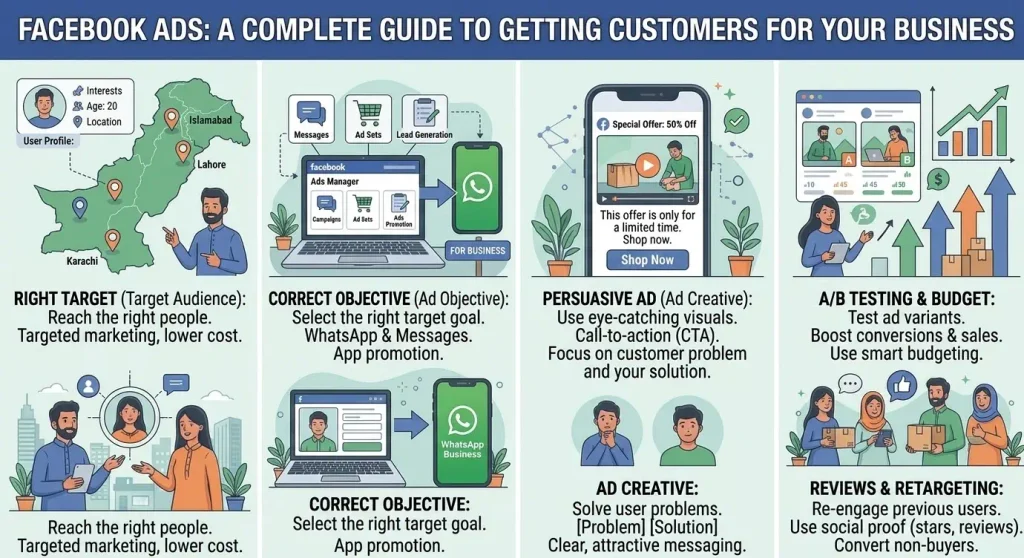
In today’s digital marketplace, social media advertising is no longer optional—it is a vital growth engine for customer acquisition. Whether you are expanding a service agency in Lahore or scaling an e-commerce shop across Pakistan, Meta Ads (Facebook & Instagram Ads) provide unprecedented targeting precision to connect with your ideal audience, generate qualified leads, and grow revenue.
With over 2.9 billion monthly active users globally, Facebook allows businesses to reach potential customers based on demographics, granular interests, online behaviors, and purchase intent. In this comprehensive 1,200+ word guide, we will explore how Facebook Ads work, key strategy frameworks, and a step-by-step process to acquire high-value customers predictably.
Why Facebook Ads Are Essential for Business Customer Acquisition
Traditional media advertising—such as billboards, print publications, and TV commercials—lacks direct attribution and demographic precision. Facebook Ads change this model by providing real-time data tracking and advanced audience selection.
Here are the primary advantages of incorporating Facebook Ads into your commercial acquisition strategy:
- Hyper-Targeted Audience Segmentation: Reach users based on specific locations, age brackets, job titles, interest categories, and online behavior patterns.
- Cost-Effective Customer Acquisition: Start with flexible daily budgets and scale up as you identify profitable audience segments and winning ad creatives.
- Full-Funnel Advertising Solutions: Build brand awareness at the top of the funnel, capture leads in the middle, and drive direct sales checkouts at the bottom.
- Measurable Return on Ad Spend (ROAS): Track exact cost-per-lead (CPL) and return on ad spend (ROAS) using performance analytics tools.
Understanding the Facebook Ad Account Hierarchy
Before launching your first campaign, it is essential to understand how Facebook Ads Manager structures advertising campaigns:
- 1. Campaign Level: Where you define your main advertising objective (e.g., Sales, Lead Generation, Traffic, or Awareness).
- 2. Ad Set Level: Where you configure target audience demographics, geographic locations, ad placements (Facebook Feed, Instagram Reels, Stories), daily budgets, and schedule settings.
- 3. Ad Level: Where you design visual ad creatives (images, videos, carousels), write copy headlines, and insert landing page destination URLs.
At MadiGiServices, we structure multi-tier campaign setups that align creative assets with specific audience intent stages.
Step-by-Step Guide to Getting Customers with Facebook Ads
Follow this framework to plan, execute, and optimize profitable Facebook ad campaigns for your business:
Step 1: Set Up Meta Business Manager and Meta Pixel
Avoid boosting posts directly from your Facebook Page. Instead, create a formal Business Manager account at business.facebook.com. Next, install the Meta Pixel (and Conversions API) on your website. The Pixel tracks visitor actions, records purchase conversions, and creates retargeting lists.
Step 2: Define Your Campaign Objective
Align your campaign objective with your business outcome:
- Leads Objective: Ideal for service agencies, real estate, and B2B businesses looking for direct form submissions or phone calls.
- Sales Objective: Essential for e-commerce stores seeking online store checkouts and product purchases.
- Traffic Objective: Drives visits to educational blog posts and informational landing pages.
Step 3: Define Your Target Customer Profiles
Identify your ideal buyer persona. Leverage Meta’s audience targeting tools across three core audience types:
- Core Audiences: Define audience location (e.g., Lahore or nationwide Pakistan), age, gender, language, and specific interest keywords (e.g., “Entrepreneurship,” “Digital Marketing,” “Online Shopping”).
- Custom Audiences: Upload existing customer email lists or re-engage website visitors who viewed specific pages.
- Lookalike Audiences (LLAs): Instruct Meta’s AI algorithm to find new prospects similar to your existing paying customers.
Step 4: Craft High-Converting Visual Creatives and Copy
Your visual creative is responsible for stopping the user’s scroll. Use high-resolution images, short video demonstrations, or carousel layouts highlighting product benefits.
Pair your visuals with persuasive ad copy structured around the PAS Framework (Problem, Agitate, Solution):
- Hook (Headline): Address a specific customer pain point immediately (e.g., “Struggling to Get Quality Leads for Your Business?”).
- Body Copy: Explain how your product or service solves the problem, supported by social proof or customer reviews.
- Call-to-Action (CTA): Direct users clearly (e.g., “Book Your Free Consultation,” “Shop Now & Get 20% Off”).
Step 5: Optimize the Post-Click Landing Page
Driving clicks is only half the battle. Your landing page must load in under 3 seconds, match the offer presented in the ad, and provide clear contact forms or checkout buttons. You can explore modern agency service page frameworks at MadiGiServices.
Proven Retargeting Strategies to Boost Conversions
Over 95% of first-time website visitors leave without making a purchase. Retargeting campaigns allow you to re-engage these warm leads and guide them back to complete their purchase.
- Abandoned Cart Retargeting: Show specific ads offering free shipping or discount incentives to users who added items to their cart but did not check out.
- Video Engagement Retargeting: Target users who watched more than 50% of your initial video ad with a follow-up testimonial ad.
Common Facebook Ads Mistakes to Avoid
Protect your advertising budget by avoiding these frequent campaign pitfalls:
- Boosting Posts Instead of Using Ads Manager: Boosting posts lacks advanced pixel tracking, detailed bidding controls, and custom conversion setups.
- Changing Campaigns Too Quickly: Changing budgets or audience settings too often resets Meta’s machine-learning algorithm before it finishes optimizing.
- Creative Fatigue: Running the same image or video for months leads to audience fatigue and rising cost-per-click (CPC) rates. Refresh creatives regularly.
Frequently Asked Questions
How much budget do I need to start Facebook Ads in Pakistan?
You can begin testing campaign setups with a daily budget of PKR 1,000 to 2,500. Once you find winning audience segmentations and ad creatives, scale your spend gradually.
What is the difference between Facebook Ads and Google Ads?
Google Ads targets search intent (users actively looking for solutions), whereas Facebook Ads targets demographic interest and behavior (displaying ads to prospective buyers based on interests).
Critical Facebook Ad Mistakes That Drain Your Budget
Running profitable Meta advertising campaigns requires avoiding operational errors that frequently increase customer acquisition costs. Steering clear of these pitfalls ensures maximum performance for every ad dollar spent:
- Audience Overlap: Targeting identical or highly similar interest groups across multiple ad sets causes your campaigns to bid against themselves, artificially driving up CPMs and reducing delivery efficiency.
- Ad Fatigue: Showing the exact same visual creatives and ad copy to the same audience for extended periods leads to declining click-through rates. Refresh ad visuals regularly to maintain active audience engagement.
- Ignoring the Meta Pixel and Conversions API: Launching ads without complete tracking implementation prevents Meta’s algorithm from learning which users convert, making automated optimization virtually impossible.
- Over-Segmenting Audiences: Creating excessively narrow target groups limits the platform’s machine learning capabilities. Modern Meta advertising performs best with broad, structured audience signals.
Scaling Strategies for High-Performing Meta Campaigns
Once you identify high-converting ad sets and profitable creative assets, expanding your reach while maintaining high profit margins requires strategic scaling methods:
- Vertical Scaling (Budget Increases): Gradually increase the daily budget of top-performing ad sets by 15% to 20% every two to three days. Rapid budget jumps can trigger re-learning phases and destabilize performance.
- Horizontal Scaling (Audience Expansion): Duplicate winning ad sets to target new lookalike audiences, complementary interests, or wider geographical locations without disturbing original settings.
- Leverage Dynamic Creative Optimization (DCO): Test multiple combinations of headlines, primary text variants, images, and call-to-action buttons simultaneously. Allow Meta’s machine learning to automatically deliver the highest-converting variations to each individual user.
Conclusion
Facebook Ads offer businesses a scalable, data-driven system to generate qualified leads and drive revenue. By setting up proper conversion tracking, crafting engaging visual creatives, and optimizing landing page experiences, your company can build a sustainable customer acquisition engine.