In the competitive digital landscape, organic strategies like SEO are critical for long-term growth, but businesses often need immediate visibility to generate leads and sales. Whether you run a local service business in Lahore or operate a nationwide e-commerce brand in Pakistan, Google Ads provides a powerful, highly targeted pay-per-click (PPC) advertising channel to connect with customers at the exact moment they search for your offerings.
However, running a profitable Google Ads campaign requires strategic planning, proper keyword targeting, and budget optimization. In this step-by-step guide, we will break down what Google Ads is, how the auction system works, and how to set up your first successful ad campaign from scratch.
What Is Google Ads and How Does It Work?
Google Ads (formerly known as Google AdWords) is Google’s online advertising platform that allows businesses to display ads across search engine results, YouTube videos, mobile apps, and millions of partner websites. It operates primarily on a Pay-Per-Click (PPC) model, meaning you only pay when a user actually clicks on your advertisement.
When users enter a search query on Google, an instant ad auction takes place. Google evaluates advertisers based on two primary metrics:
- Maximum Bid: The highest amount you are willing to pay for a click on your ad.
- Quality Score: A rating (from 1 to 10) evaluating your ad relevance, expected click-through rate (CTR), and landing page experience.
By combining your bid with your Quality Score, Google determines your Ad Rank. This means a well-optimized ad with high relevance can rank above competitors even with a lower budget bid.
Core Types of Google Ads Campaigns
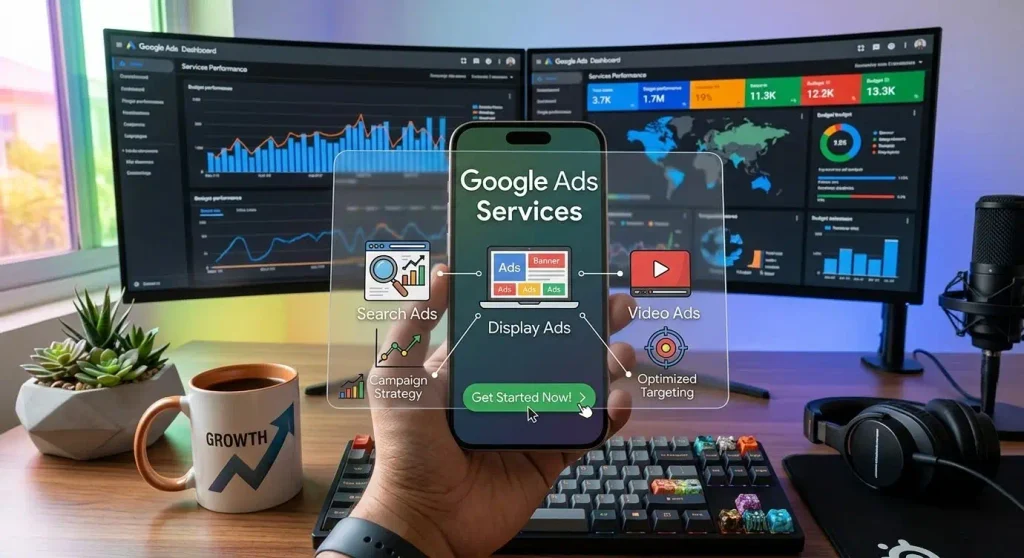
Depending on your business objectives, Google offers several specialized ad campaign formats:
1. Search Network Ads
Text-based advertisements displayed directly at the top or bottom of Google search results pages when users search for specific targeted keywords.
2. Display Network Ads
Visual banner advertisements shown across millions of websites and apps within Google’s partner network to build brand awareness.
3. Google Shopping Ads
Product listing ads displaying product images, titles, pricing, and store names—ideal for e-commerce store platforms.
4. Video Ads (YouTube)
Video advertisements running before, during, or after YouTube video content to engage visual audiences.
At MadiGiServices, we help companies align paid campaign choices with clear conversion goals to maximize return on ad spend (ROAS).
Step-by-Step Guide to Launching Your First Google Ads Campaign
Follow this practical framework to build and launch your initial Google Search campaign correctly:
Step 1: Set Up Your Google Ads Manager Account
Visit the official Google Ads portal and sign in with your corporate Google email. Complete your business setup details and configure your billing profile and local payment preferences.
Step 2: Define Your Campaign Objective
Select a goal that matches your business priority: Leads (phone calls or form submissions), Sales (online store checkouts), or Website Traffic. Choosing a defined goal helps Google tailor automated bidding suggestions.
Step 3: Select Campaign Type and Location Targeting
Select “Search Campaign” for high intent traffic. Next, configure geographic location targeting. You can target specific cities like Lahore, Karachi, or Islamabad, or run nationwide campaigns across Pakistan. Specify target languages to reach your preferred demographic.
Step 4: Set Your Daily Budget and Bidding Strategy
Define a realistic daily spending limit you feel comfortable with. For beginners, start with a “Maximize Clicks” bidding strategy to gather initial traffic data, or set a manual Cost-Per-Click (CPC) limit to prevent budget overruns.
Step 5: Conduct Keyword Research and Grouping
Organize keywords into tight, relevant ad groups. Use Google Keyword Planner to find high-intent commercial keywords and select appropriate match types:
- Exact Match
[keyword]: Triggers ads only for exact search terms. - Phrase Match
"keyword": Triggers ads for searches containing the keyword phrase in order. - Negative Keywords: Exclude irrelevant terms (e.g., “free,” “jobs,” “cheap”) to prevent wasted spend.
Step 6: Write High-Converting Responsive Search Ads
Create compelling ad copy containing clear call-to-actions (CTAs). Responsive Search Ads allow you to enter multiple headlines and descriptions, which Google tests automatically to deliver optimal combinations:
- Include primary target keywords inside main headlines.
- Highlight key business advantages (e.g., “24/7 Expert Support,” “Fast Delivery Across Pakistan”).
- Add Sitelink and Call Assets (extensions) to increase overall ad space and CTR.
Step 7: Optimize Your Landing Page Experience
Your ad copy must match the landing page content seamlessly. Ensure your landing page loads fast, displays mobile responsiveness, and features clear inquiry forms or purchasing options. To inspect well-structured landing page setups, check out the service framework at MadiGiServices.
Common Google Ads Mistakes to Avoid
Avoid these common mistakes that lead to wasted ad budgets:
- Relying Broadly on Broad Match Keywords: Broad match without negative keyword lists brings low-quality, irrelevant clicks.
- Ignoring Conversion Tracking: Failing to install Google Tag Manager and conversion tags makes evaluating ROI impossible.
- Sending All Traffic to the Homepage: Direct users to specific, relevant product or service landing pages rather than a generic homepage.
Frequently Asked Questions
How much budget do I need to start Google Ads in Pakistan?
You can start with a modest daily budget (e.g., PKR 1,500 to 3,000 per day) and scale your spend as you identify profitable keywords and high-converting ad groups.
What is the difference between SEO and Google Ads?
SEO delivers long-term, organic search traffic without paying for individual clicks, while Google Ads provides immediate, paid search visibility that lasts as long as your campaign budget remains active.
Common Google Ads Campaign Pitfalls to Avoid
To ensure your advertising budget generates maximum return on investment (ROI), it is critical to avoid several frequent mistakes that marketers often make during campaign setup and management:
- Neglecting Negative Keywords: Failing to add negative keywords allows your ads to trigger for irrelevant searches, wasting precious budget on unqualified clicks that will never convert.
- Sending Traffic to the Homepage: Directing users to a generic homepage instead of a dedicated, highly relevant landing page creates friction and drastically reduces your conversion rate.
- Ignoring Ad Extensions: Omitting assets like sitelinks, callouts, and structured snippets reduces your ad’s screen real estate and click-through rate (CTR) compared to competitors.
- Focusing Solely on Clicks Over Conversions: High traffic is meaningless without measurable sales or inquiries. Always configure proper conversion tracking before launching any campaign.
Advanced Optimization Strategies for Sustained Growth
Once your initial Google Ads campaign gains traction, implementing strategic optimization techniques will significantly lower your acquisition costs while scaling performance:
- Implement Smart Bidding Strategies: Leverage Google’s machine learning tools, such as Target CPA (Cost Per Acquisition) or Target ROAS (Return On Ad Spend), to automatically adjust bids for high-converting queries in real time.
- Refine Demographic Targeting: Analyze performance metrics across age groups, gender, geographic locations, and income levels to focus your spending strictly on your most profitable audience segments.
- A/B Test Ad Copies Continuously: Always run multiple active ad variations simultaneously. Test different headlines, emotional triggers, and value propositions to systematically identify the messaging that yields the highest CTR and lowest CPC.
Conclusion
Google Ads is an indispensable acquisition engine for growing businesses. By defining clear campaign goals, targeting high-intent long-tail keywords, and continuously optimizing landing pages, your company can achieve scalable digital growth and a strong ROI۔