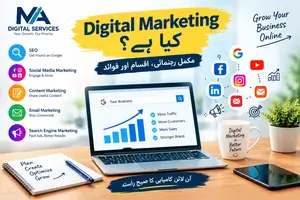
In today’s hyper-connected global economy, traditional marketing channels such as print, billboards, and television commercials are no longer sufficient to maintain a competitive advantage. Consumers and businesses alike rely on search engines, social media networks, email communications, and digital platforms to discover products, evaluate services, and make purchasing decisions. Whether you are running a local service agency in Lahore or expanding an e-commerce enterprise across Pakistan, establishing a robust digital marketing strategy is critical for sustainable commercial acquisition and long-term brand equity.
Digital marketing encompasses every promotional effort that utilizes electronic devices or the internet to connect with prospective clients. In this comprehensive 1,300+ word guide, we will explore what digital marketing is, its primary advantages over traditional advertising, its core tactical channels, and a step-by-step strategic blueprint to build a high-converting digital presence.
What Is Digital Marketing?
Digital marketing—also referred to as online marketing—is the strategic promotion of brands, products, or services using digital technology and online communication channels. Unlike offline promotional tactics, digital marketing leverages data-driven channels to engage prospective customers across every stage of the buying journey.
At its core, digital marketing involves meeting potential customers where they spend a significant portion of their daily time: on search engines like Google, social media applications like Meta and LinkedIn, digital publication websites, and direct communication platforms like email and messaging apps.
Digital Marketing vs. Traditional Marketing
Understanding the fundamental distinctions between traditional and digital marketing highlights why modern businesses prioritize online channels for commercial growth:
- Granular Audience Targeting: Traditional advertising broadcasts messages to a general audience. Digital marketing allows businesses to target users based on precise demographics, geographic locations, online behaviors, personal interests, and commercial search intent.
- Measurable Real-Time Analytics: Offline media yields vague performance estimations. Digital marketing provides transparent analytics, enabling real-time tracking of website visits, click-through rates (CTR), cost-per-lead (CPL), and return on ad spend (ROAS).
- Cost Efficiency & Scalability: Digital campaigns accommodate flexible budgets, allowing small businesses to compete alongside established enterprises. Campaigns can be paused, scaled, or optimized instantly based on performance metrics.
- Two-Way Customer Engagement: Traditional marketing acts as a one-way communication broadcast. Digital marketing fosters interactive dialogue through social comments, live chats, email replies, and instant messaging.
At MadiGiServices, we combine multi-channel digital strategies to convert online visibility into predictable revenue generation.
Core Pillars of Digital Marketing
A comprehensive digital strategy relies on several interconnected disciplines working together to capture user attention and nurture leads:
1. Search Engine Optimization (SEO)
Search Engine Optimization is the practice of optimizing your website content and technical structure to rank higher on search engine results pages (SERPs) for
relevant search queries. SEO is broadly divided into three core focus areas:
- On-Page SEO: Optimizing on-site content, title tags, meta descriptions, internal link structures, and heading tags (H1, H2, H3) around targeted keywords.
- Off-Page SEO: Building domain authority and trustworthiness through quality backlink acquisition, brand mentions, and external citations.
- Technical SEO: Ensuring rapid page speed (Core Web Vitals), mobile-first responsiveness, clean sitemap submissions, and proper search engine indexation.
2. Pay-Per-Click (PPC) Advertising
PPC is an online advertising model where marketers pay a fee each time a user clicks on their ad. Google Ads is the most widely utilized search engine advertising platform, allowing brands to display paid search listings at the exact moment users search for specific products or services.
3. Social Media Marketing (SMM)
Social media marketing involves using platforms like Facebook, Instagram, LinkedIn, TikTok, and YouTube to build brand awareness, engage target audiences, and drive traffic. Through organic posting and paid Meta Ads campaigns, businesses can reach prospective buyers through highly visual, interactive creative formats.
4. Content Marketing
Content marketing centers on generating and distributing valuable, relevant, and consistent educational content—such as blog articles, e-books, case studies, and infographics—to attract and retain a clearly defined target audience. Rather than pushing hard sales messages, content marketing solves real customer problems to establish brand trust.
5. Email Marketing
Email marketing remains one of the highest-yielding digital sales channels. By capturing visitor contact details through lead magnets, businesses can build direct relationships, deliver automated onboarding series, share product announcements, and nurture long-term client retention.
6. Conversion Rate Optimization (CRO)
Driving traffic to a website is only half the goal; converting visitors into leads or buyers is what drives profit. CRO involves analyzing website analytics, running A/B tests, and refining user experience (UX) design to increase the percentage of site visitors who complete desired conversion actions.
To examine structured digital marketing frameworks and agency implementation models, review the service setups at MadiGiServices.
Step-by-Step Blueprint to Launch a Successful Digital Marketing Strategy
To construct a profitable digital marketing engine for your company, execute the following strategic stages:
Step 1: Define Target Audience Personas
Create detailed buyer profiles outlining your ideal clients’ demographics, job functions, pain points, preferred online communication channels, and primary purchasing motivations.
Step 2: Set Measurable Key Performance Indicators (KPIs)
Establish specific, measurable commercial metrics aligned with your growth goals. Examples include increasing organic monthly traffic by 40%, lowering cost-per-lead (CPL) by 20%, or achieving a 4x Return on Ad Spend (ROAS).
Step 3: Build a High-Performing Digital Infrastructure
Ensure your business website is fast, secure (SSL certified), optimized for mobile devices, and designed with intuitive navigation. Your website acts as the central destination for all incoming digital traffic.
Step 4: Execute a Multi-Channel Acquisition Strategy
Deploy a balanced blend of immediate lead acquisition tools (Google Ads & Meta Ads) alongside long-term organic growth investments (SEO & Content Marketing) to ensure both immediate cash flow and sustained search visibility.
Step 5: Measure, Analyze, and Optimize
Continuously monitor performance data using tools like Google Analytics 4 (GA4) and Google Search Console. Analyze user behavior patterns, double down on high-performing ad creatives or keywords, and adjust underperforming assets.
Common Digital Marketing Pitfalls to Avoid
Protect your marketing budget from these frequent execution mistakes:
- Ignoring Mobile Experience: Over 60% of web traffic comes from mobile screens. A site that operates poorly on smartphones degrades user trust and search rankings.
- Focusing Entirely on Vanity Metrics: Likes, shares, and impressions look positive, but sales checkouts, qualified inquiries, and ROAS define real business success.
- Expecting Overnight Success from Organic SEO: Organic search rankings and content authority require consistent publishing and technical care over 3 to 6 months before yielding full results.
Frequently Asked Questions
How much should a business invest in digital marketing?
Marketing budgets vary based on business stage and goals. Generally, growing businesses allocate 7% to 12% of their total annual revenue toward comprehensive digital marketing efforts.
Which digital marketing channel delivers the fastest results?
Paid advertising (Google Ads and Meta Ads) provides immediate visibility and traffic within hours of campaign launch, whereas organic channels like SEO build compounding long-term growth.
Conclusion
Digital marketing is an indispensable engine for modern commercial expansion. By identifying clear target audience personas, maintaining a fast and mobile-first website, deploying multi-channel acquisition tactics, and consistently analyzing data, your company can build a scalable, high-converting digital marketing framework.
For custom digital strategy, SEO audits, and multi-channel marketing campaigns, explore dedicated agency solutions at MadiGiServices today.