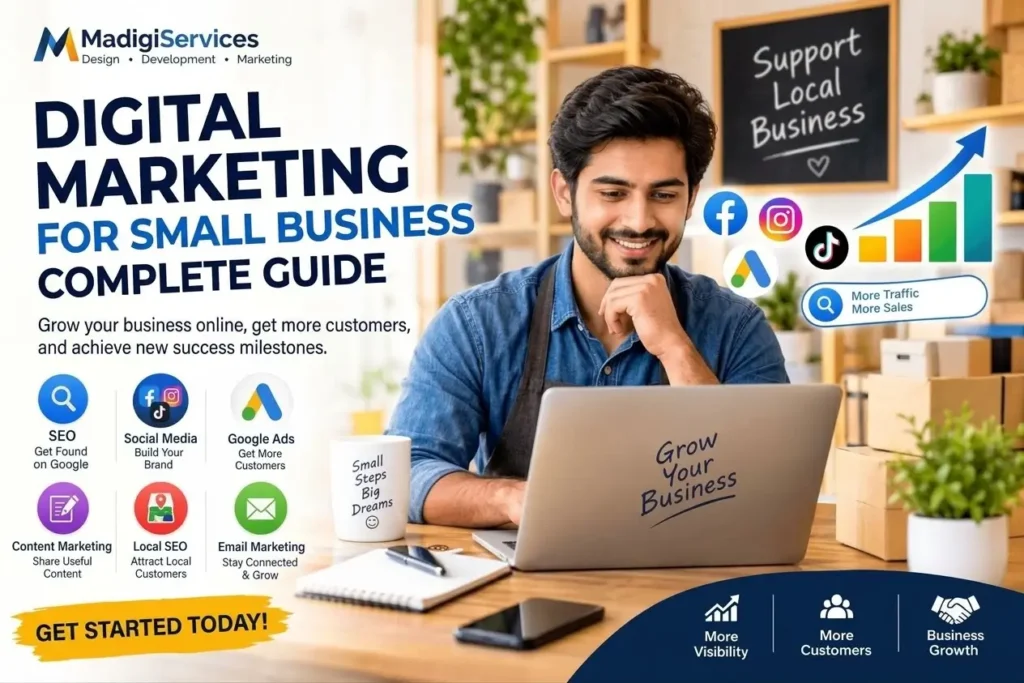
For small and medium-sized enterprises (SMEs), building a sustainable stream of new customers without an enterprise-level budget is one of the most critical challenges. Whether you operate a boutique retail store, a local service agency in Lahore, or a growing e-commerce brand, modern consumer behavior demands a strategic online presence. Consumers no longer rely solely on foot traffic or word-of-mouth recommendations; they actively search Google, scroll social media platforms, and read customer reviews before spending a single rupee.
Digital marketing bridges the gap between small businesses and high-intent buyers, allowing small companies to compete side-by-side with industry leaders. In this comprehensive 1,300+ word guide, we will explore a practical, cost-effective digital marketing framework designed specifically for small businesses to maximize return on ad spend (ROAS) and generate sustainable growth.
Why Digital Marketing is Essential for Small Businesses
Unlike traditional offline channels like newspaper prints or billboards, digital marketing provides small business owners with three distinct advantages:
- Budget Efficiency and Control: You can start campaigns with minimal daily spend, test what messaging works, and adjust budgets instantly based on revenue results.
- Hyper-Targeted Reach: Instead of broadcasting to everyone, digital marketing allows you to target users by city, age group, specific interests, and immediate search intent.
- Trackable ROI: Every click, phone call, form submission, and online checkout can be tracked using web analytics, ensuring complete visibility into your marketing investment.
At MadiGiServices, we help small businesses construct scalable multi-channel acquisition models to transform online visibility into reliable revenue.
Step-by-Step Digital Marketing Blueprint for Small Businesses
To achieve maximum commercial impact with a limited budget, execute these core digital marketing channels in order of priority:
1. Claim and Optimize Your Google Business Profile (Local SEO)
For location-based small businesses, Local SEO is the single highest-converting organic channel. Claiming and fully optimizing your Google Business Profile ensures your company appears at the top of Google Maps and local search results when nearby customers search for your services.
- Ensure your Business Name, Address, and Phone Number (NAP) are accurate and consistent across the web.
- Collect genuine 5-star Google reviews from satisfied clients to build immediate commercial trust.
- Upload high-quality business photos and keep opening hours regularly updated.
2. Build a Fast, Mobile-Responsive Business Website
Your website serves as your central digital storefront where all promotional traffic lands. A slow or confusing website will waste your hard-earned ad spend. Focus on creating a clean, high-speed website with intuitive navigation, clear value propositions, and easy-to-find Call-to-Action (CTA) buttons like “WhatsApp Us” or “Book a Free Consultation.”
Learn how to structure effective agency website layouts and page flows by viewing examples at MadiGiServices.
3. Invest in Search Engine Optimization (SEO) for Long-Term Organic Traffic
SEO allows your small business to rank on Google search results without paying for every single click. Focus heavily on low-competition, high-intent local keywords that match your specific product offerings.
- On-Page SEO: Write high-value blog articles that solve real customer problems and optimize your page titles, headings (H1, H2, H3), and image ALT text.
- Technical SEO: Ensure your website loads quickly on mobile screens, installs an SSL certificate for security, and maintains clean URL structures.
4. Leverage Social Media Marketing and Targeted Paid Ads
Social media platforms like Facebook, Instagram, LinkedIn, and TikTok are not just for connecting; they are powerful tools for customer acquisition. A small business must leverage these channels through both organic content and precise advertising.
Key Strategies for Organic Social Success
- Consistent Publishing Schedule: Develop a content calendar with post types (educational, entertaining, promotional).
Tip: Use a mix of Reels, Stories, and static posts for maximum reach. - Engage, Don’t Just Post: Actively respond to comments and messages to build community.
- Define Your Target Audience Personas: Create profiles to understand your ideal customers.
- Highlight User-Generated Content (UGC): Encourage customers to share their experiences.
Unlocking Growth with Targeted Paid Ads
Small business budgets can be highly effective with the right strategy:
- Identify the Best Platform: Match your product to the appropriate platform demographics (e.g., LinkedIn for B2B, TikTok for Gen Z).
- Precise Audience Targeting: Utilize demographic, interest, and behavioral targeting options.
- A/B Testing Creatives: Test different ad copies, images, and videos.
- Run Retargeting Campaigns: Re-engage users who visited your website.
- Implement Conversion Tracking: Set up pixels to measure ROI.
- Optimize for Call-to-Actions (CTAs): Use clear commands like “Book Now” or “Get a Quote.”
- Manage Your Ad Spend Wisely: Start small and scale winning campaigns.
Pro Tip for Local Businesses
- Use hyper-local geo-targeting to show ads to customers within a very specific radius (e.g., 2 miles from your store).
5. Build Direct Relationships via Email & WhatsApp Marketing
Acquiring new customers is more expensive than retaining existing ones. Collect customer contact details during checkouts or inquiries and build automated follow-up series. Sending regular, helpful newsletters, special promotional discounts, and service reminders via Email and WhatsApp Business builds brand loyalty and drives repeat sales.
Common Digital Marketing Mistakes Small Businesses Should Avoid
Protect your capital and efforts by avoiding these common strategy mistakes:
- Trying to Be Everywhere at Once: Do not spread yourself thin across every social media platform. Pick two core channels where your target audience spends most of their time and master them first.
- Focusing Entirely on Vanity Metrics: Page likes and views do not pay bills. Focus your efforts on generating actual qualified inquiries, phone calls, and revenue checkouts.
- Neglecting Analytics and Tracking: Without setting up Google Analytics 4 (GA4) and Facebook Pixel, you cannot accurately measure which marketing campaigns are making money and which are wasting cash.
Frequently Asked Questions
What is the minimum budget required for a small business to start digital marketing?
Small businesses can start running paid ad campaigns on platforms like Meta with as little as $5 to $10 per day, adjusting the spend upward as campaigns demonstrate profit.
How long does it take to see actual business results from digital marketing?
Paid campaigns (Google Ads and Meta Ads) can yield inquiries within 24 to 48 hours. Organic strategies like SEO and Content Marketing usually take 3 to 6 months to generate compounding traffic.
Conclusion
Digital marketing provides small businesses with an unparalleled growth vehicle to build market presence, engage targeted local audiences, and scale commercial revenue efficiently. By starting with Google Local SEO, building a fast mobile site, leveraging targeted paid campaigns, and analyzing performance data, small businesses can achieve sustainable commercial expansion.
For custom small business strategies, SEO optimization, and ad campaign setups, explore solutions at MadiGiServices today.