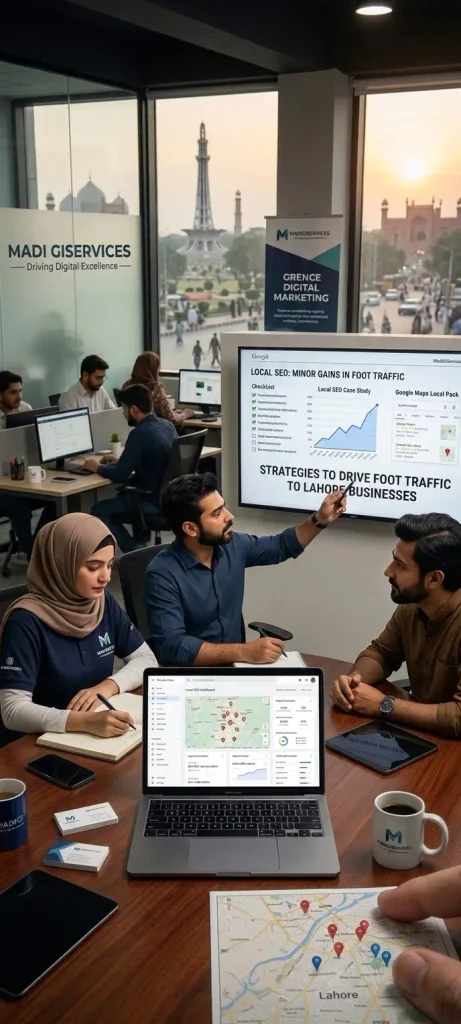
In today’s digital-first economy, when consumers want to buy a coffee, find a mechanic, or visit a boutique, they don’t flip through phone directories anymore. They pull out their smartphones, open Google, and search for services “near me.” For brick-and-mortar stores, local service providers, and multi-location enterprises, capturing these high-intent local searchers is the ultimate key to survival and growth.
At MadiGiServices, we understand that getting people to find your website is only half the battle; the ultimate goal for local businesses is driving physical foot traffic through the front door. If your storefront is empty despite having a decent website, your local search engine optimization (SEO) strategy needs a serious overhaul.
This comprehensive guide dives deep into actionable, proven Local SEO strategies designed to dominate local search results, build community trust, and significantly boost foot traffic to your physical business.
What is Local SEO and Why Does It Matter?
Local SEO is the practice of optimizing your online presence to attract more business from relevant local searches. These searches take place on Google and other search engines, heavily driven by location-based intent.
When a user searches for “best digital marketing agency in Lahore” or “coffee shop near me,” Google displays a specialized map pack alongside traditional organic results. Appearing in this coveted “Local Pack” (the top three map listings) puts your business directly in front of consumers who are ready to visit a store or make a purchase that very day.
The Core Benefits of Local SEO:
- High Conversion Intent: Local searches are fueled by immediate needs. Statistics show that nearly 76% of people who search for something nearby on their smartphone visit a business within 24 hours, and 28% of those searches result in a purchase.
- Cost-Effective Marketing: Unlike traditional advertising (billboards, flyers, print ads), Local SEO targets consumers who are already looking for your exact services.
- Building Local Authority: Dominating local search results establishes your business as a trusted, authoritative brand within your community.
1. Optimize Your Google Business Profile (GBP) for Maximum Visibility
Your Google Business Profile (formerly Google My Business) is the absolute cornerstone of any successful local SEO campaign. Without an optimized GBP, your chances of appearing in Google’s Local Pack are nearly zero.
Actionable Steps to Optimize Your GBP:
- Claim and Verify Your Listing: Ensure you officially own and manage your business profile. If you operate a service-area business without a storefront, hide your address correctly according to Google’s guidelines while setting your service radiuses accurately.
- Complete Every Single Section: Do not leave fields blank. Provide your exact business name, phone number, website URL, operating hours, and business categories. Choose a precise primary category (e.g., “Digital Marketing Agency”) and relevant secondary categories.
- Write a Compelling Business Description: Incorporate your primary local keywords naturally within a 750-character description highlighting what makes your business unique.
- Add High-Quality Visuals: Profiles with photos receive significantly more requests for driving directions and clicks to their websites. Upload high-resolution images of your storefront, interior, team members, and core products or services.
- Maintain NAP Consistency: Ensure your Name, Address, and Phone Number (NAP) match identically across your website, GBP listing, and all online directories.
2. Master Local Keyword Research with Intent
Traditional SEO focuses on broad, global keywords. Local SEO requires a hyper-targeted approach that integrates geographic modifiers (city names, neighborhoods, landmarks, and “near me” phrases).
How to Conduct Local Keyword Research:
- Identify Core Services + Location: Combine what you sell with where you sell it. For example, instead of targeting “SEO services,” target “SEO services in Lahore” or “affordable web design agency in [City Name]”.
- Leverage Google Autocomplete: Type your service into Google followed by different local areas to see what real users are actively searching for.
- Analyze Competitors: Look at top-ranking local competitors to see what keywords they are ranking for using tools like SEMrush, Ahrefs, or Google Keyword Planner.
- Incorporate Long-Tail Conversational Queries: With voice search on mobile devices growing rapidly, optimize for questions like “Where is the best digital agency near me open right now?”
3. Generate and Manage Authentic Customer Reviews
Online reviews act as modern word-of-mouth recommendations. Google’s algorithm heavily weighs the quantity, velocity, quality, and sentiment of reviews when ranking local businesses in the map pack. Furthermore, positive reviews heavily influence a consumer’s decision to walk through your doors.
Best Practices for Review Generation:
- Ask at the Right Time: Train your staff to ask satisfied customers for a review immediately after a successful transaction or project delivery.
- Simplify the Process: Send automated SMS or email follow-ups containing a direct, one-click link to your Google Business Profile review form.
- Respond to Every Review: Always reply to positive reviews with gratitude, personalizing the message when possible. More importantly, handle negative reviews professionally, empathetically, and promptly to demonstrate to prospective customers that you care about client satisfaction.
- Never Buy Fake Reviews: Google’s automated filters easily detect fake reviews, which can result in severe penalties or the permanent suspension of your listing.
4. Ensure Mobile-Friendliness and Local Page Speed
The majority of local searches happen on mobile devices while people are on the go. If your website takes more than three seconds to load on a smartphone, or if users have to pinch and zoom to read your text, they will bounce immediately to a competitor.
Technical Local SEO Enhancements:
- Responsive Design: Ensure your website layout adapts seamlessly across smartphones, tablets, and desktop computers.
- Click-to-Call Buttons: Make your phone number clickable on mobile versions so customers can call your business instantly with a single tap.
- Optimize Core Web Vitals: Compress images, leverage browser caching, and utilize reliable hosting to keep load times lightning fast.
- Clear Location Details: Feature your physical address, interactive Google Maps embedding, and store hours prominently in your website footer and contact page.
5. Build Local Citations and Localized Backlinks
Citations are mentions of your business name, address, and phone number on other websites, directories, and local business associations. They validate your business legitimacy to search engines.
Effective Citation and Link Building Strategies:
- List on High-Authority Directories: Submit your business to trusted global and local directories such as Yelp, YellowPages, TripAdvisor, Foursquare, and region-specific business chambers.
- Sponsor Local Events or Charities: Partner with local schools, sports teams, or community events. These sponsorships frequently result in high-authority local .edu or .org backlinks pointing directly to your site.
- PR and Local Media Outlets: Pitch unique stories about your business to local newspapers, blogs, and digital news portals to earn valuable editorial backlinks and brand mentions.
6. Create Hyper-Local Content Strategy
Publishing content tailored specifically to your local audience builds topical authority and captures niche search traffic that broader competitors miss.
Ideas for Local Content Creation:
- Write Location-Specific Landing Pages: If you serve multiple areas or neighborhoods, create dedicated landing pages for each location highlighting localized case studies, client testimonials, and regional services.
- Cover Local Community News or Events: Publish blog posts about local industry events, sponsorships, or guides like “Top 10 Business Growth Tips for Local Startups in [City Name]”.
- Use Schema Markup (LocalBusiness Schema): Implement structured data markup on your website to explicitly inform search engines about your business type, address, operating hours, geo-coordinates, and price range.
Measuring Success: Tracking Your Local SEO Performance
To ensure your local campaigns are successfully driving foot traffic, track the right Key Performance Indicators (KPIs):
- GBP Insights: Monitor metrics like direct and discovery searches, map views, website clicks, and phone call requests directly from your dashboard.
- Organic Local Traffic: Use Google Analytics to monitor traffic coming from your target geographic locations.
- Rank Tracking: Track your positions in local map packs and organic search results for primary local keywords.
Conclusion
Driving physical foot traffic in a digital age requires bridging the online gap with your offline storefront. By claiming your Google Business Profile, optimizing for mobile users, gathering glowing reviews, and creating hyper-local content, you position your business as the ultimate local authority in your industry.
At MadiGiServices, we specialize in crafting robust, data-driven Local SEO strategies that transform online impressions into real-world customers. Implement these proven strategies today, open your doors, and watch your foot traffic multiply!