
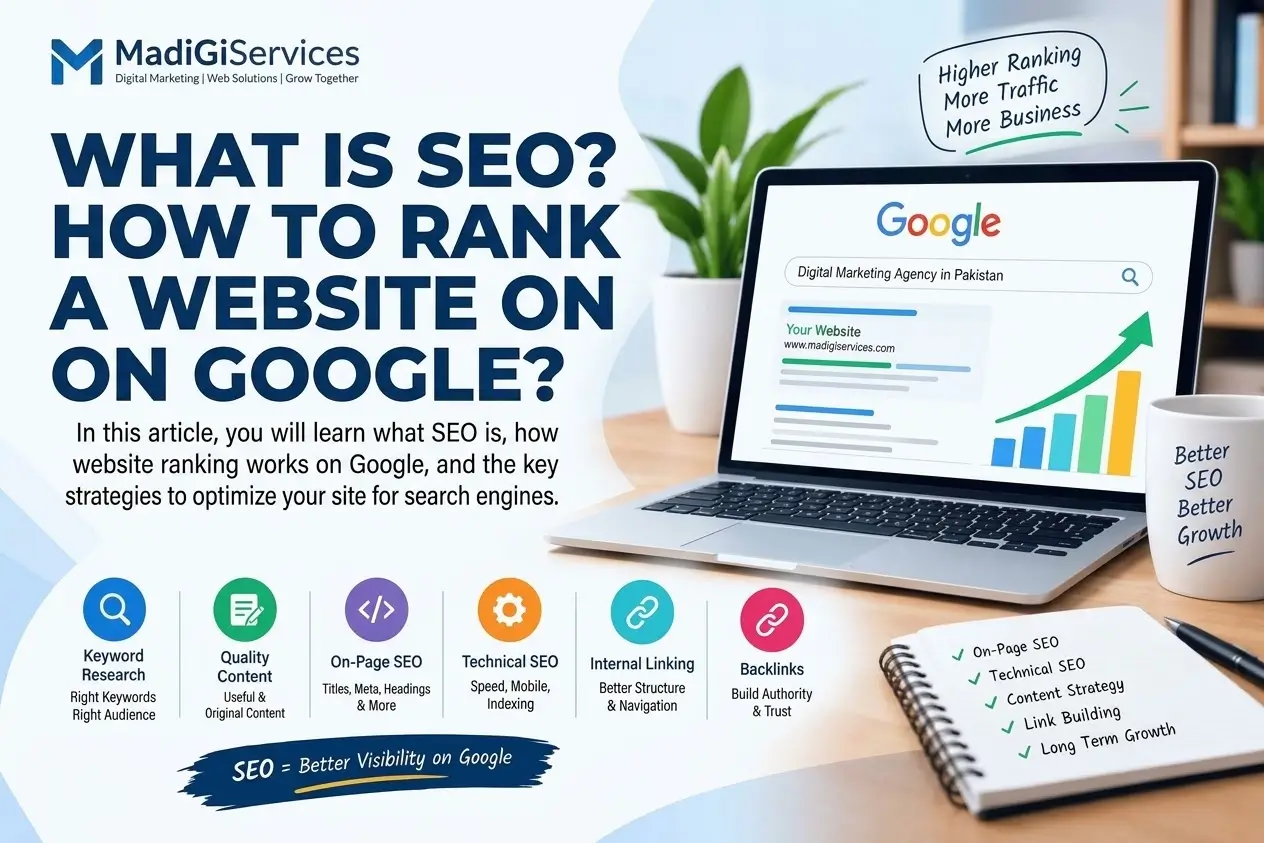
In the modern digital landscape, establishing an online business or publishing valuable content is only the first step toward commercial success. With over 8.5 billion searches processed by Google every single day, standing out among millions of competing websites requires a strategic approach. Search Engine Optimization (SEO) is the primary methodology that enables websites to secure top visibility on Google Search Engine Results Pages (SERPs), driving high-intent organic traffic without relying on continuous paid advertising expenditures.
Whether you operate a corporate service firm, an e-commerce platform, or a specialized content blog in Pakistan, mastering SEO is essential for sustainable brand acquisition and long-term search authority. In this definitive 1,260+ word guide, we will explore what SEO is, how Google evaluates and ranks web pages, the core pillars of modern optimization, and a practical step-by-step ranking strategy.
What Is Search Engine Optimization (SEO)?
Search Engine Optimization (SEO) is the art and science of optimizing a website’s technical configuration, content relevance, and link authority to rank higher on organic search engine results. Unlike Pay-Per-Click (PPC) advertising, where traffic halts the moment ad budgets dry up, organic SEO delivers continuous, high-converting traffic over time.
When prospective buyers search for queries related to your industry, products, or services, search engines evaluate billions of indexed documents to present the most accurate, trustworthy, and user-friendly pages. SEO ensures that your site satisfies these algorithmic criteria effectively.
How Does Google Work? The Three Core Stages
To understand how a website ranks on Google, you must first understand how Google discovers and processes information across the web. Google operates through three sequential stages:
1. Crawling
Google utilizes automated software programs called web crawlers or spiders (Googlebot) to discover newly published or updated web pages. Crawlers travel across the internet by following hyperlinks from known pages to new ones. If your site lacks clean internal linking or blocks spiders via a restrictive robots.txt file, Google cannot discover your content.
2. Indexing
Once a page is crawled, Google analyzes its textual content, structural tags, images, and visual layout to determine what the page is about. This information is stored in the Google Index—a massive global database containing hundreds of billions of web pages. Pages that contain duplicate content, technical errors, or poor user value may be rejected during the indexing phase.
3. Serving and Ranking
When a user types a search query into Google, the algorithm searches the index for the most relevant and high-quality answers. Google applies over 200 ranking signals to determine the exact order in which web pages appear on the search results screen.
To examine structured SEO workflows and website management setups, review the agency frameworks at MadiGiServices.
The Core Pillars of Search Engine Optimization
A successful SEO campaign requires a balanced strategy across four interconnected disciplines:
1. On-Page SEO (Content & Relevance)
On-Page SEO focuses on optimizing individual page elements to align with specific target search terms (keywords). Key elements include:
- Keyword Optimization: Researching user search intent and naturally incorporating primary and secondary keywords into page titles, headings (H1, H2, H3), and body text.
- Title Tags & Meta Descriptions: Writing compelling HTML meta elements that encourage users to click your link on search engine results pages.
- High-Quality Useful Content: Producing comprehensive, original content that thoroughly answers the user’s search query while meeting Google’s E-E-A-T (Experience, Expertise, Authoritativeness, and Trustworthiness) standards.
- Internal Linking: Connecting relevant articles within your website to distribute page authority and guide user navigation.
2. Off-Page SEO (Authority & Trust)
Off-Page SEO encompasses activities performed outside of your domain to build overall search authority and brand reputation. The core foundation of off-page SEO is backlink acquisition. A backlink is a link from an external website pointing to your site
, acting as a vote of confidence in the eyes of Google.
High-authority backlinks from reputable, niche-relevant websites signal to Google that your site is trustworthy, significantly boosting your ranking potential.
3. Technical SEO (Performance & Infrastructure)
Technical SEO ensures that your website infrastructure is fully optimized for search crawlers and provides a seamless technical experience for visitors. Essential technical factors include:
- Page Load Speed (Core Web Vitals): Optimizing image sizes, browser caching, and code structure to ensure instant page load times.
- Mobile Responsiveness: Utilizing mobile-first responsive web design, as Google evaluates pages based on their smartphone user experience.
- SSL Certificate (HTTPS): Securing your website with encryption to protect user data and meet basic search security benchmarks.
- XML Sitemap & Robots.txt: Submitting clear sitemaps through Google Search Console to facilitate efficient search engine crawling.
4. Local SEO (Geographic Targeting)
Local SEO targets geographically specific search queries (e.g., “digital marketing agency in Lahore”). By optimizing your Google Business Profile, accumulating local customer reviews, and building local business citations, your brand can secure top placement in Google’s Local Map Pack.
Learn how to integrate multi-channel growth tactics alongside technical search optimization at MadiGiServices.
Step-by-Step Blueprint: How to Rank Your Website on Google
To systematically rank your website on Google’s front page, execute this proven SEO implementation process:
Step 1: Conduct In-Depth Keyword Research
Identify target terms using tools like Google Keyword Planner, Ahrefs, or SEMrush. Focus on long-tail keywords—specific phrases with moderate search volume and lower competition—to gain early ranking traction.
Step 2: Understand and Satisfy Search Intent
Analyze the top 10 search results for your primary keyword. Determine whether searchers are looking for informational articles, commercial service pages, or direct product checkouts, and tailor your content format accordingly.
Step 3: Craft In-Depth, SEO-Optimized Content
Write comprehensive, engaging articles that solve customer pain points completely. Use structured formatting with H2 and H3 subheadings, bullet points, and optimized images with descriptive ALT text.
Step 4: Fix Technical Errors in Google Search Console
Set up Google Search Console and Google Analytics 4 (GA4). Routinely monitor your dashboard to resolve mobile usability errors, page speed bottlenecks, and indexation issues.
Step 5: Build Relevant Backlinks and Brand Mentions
Publish valuable research, infographics, or guest publications to earn natural backlinks from authoritative blogs within your industry niche.
Common SEO Mistakes That Prevent Higher Rankings
Avoid these critical execution errors that can trigger algorithmic penalties or suppress organic rankings:
- Keyword Stuffing: Overloading your content with repetitive target keywords destroys readability and earns search penalties from Google.
- Buying Low-Quality Spam Backlinks: Acquiring thousands of automated links from link farms harms your site’s domain trust.
- Ignoring Mobile UX: Neglecting mobile optimization alienates over 60% of web traffic and degrades your search visibility.
- Expecting Instant Results: SEO is a long-term compound growth strategy; significant organic ranking progress generally takes 3 to 6 months of consistent work.
Frequently Asked Questions
How long does it take for a new website to rank on Google?
For brand new domains, achieving first-page rankings typically takes between 3 to 6 months of consistent content publishing, technical refinement, and link-building efforts.
Is SEO better than paid Google advertising?
Both channels serve distinct commercial purposes. Google Ads generates immediate visibility and leads, while SEO builds compounding, long-term organic equity that lowers customer acquisition costs over time.
Conclusion
SEO is an essential component of modern digital growth. By establishing a robust technical foundation, publishing high-value content, optimizing on-page elements, and earning authoritative backlinks, your website can build search dominance on Google and capture steady commercial traffic.
For expert SEO audits, technical web development, and organic growth strategies, explore tailored digital solutions at MadiGiServices today.